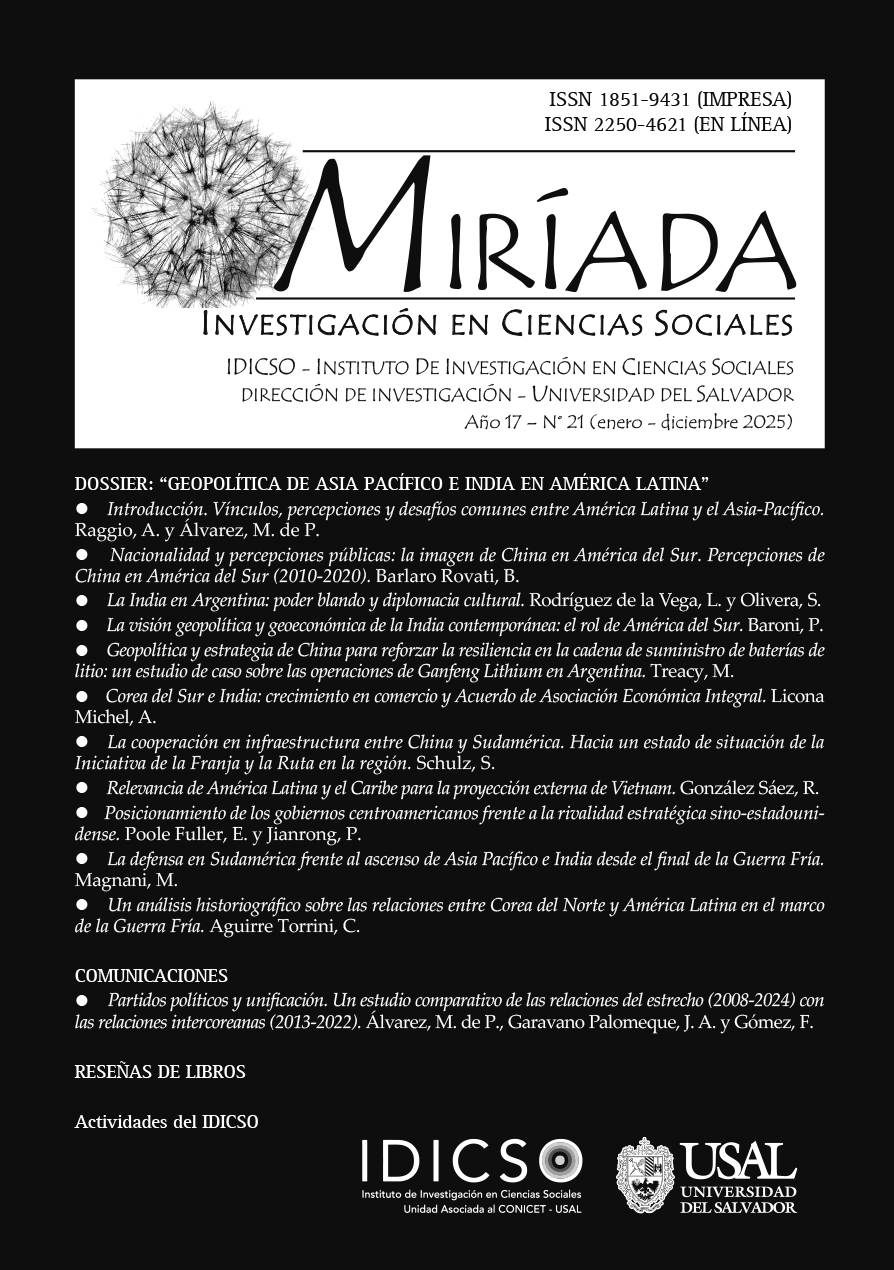
Nacionalidad y percepciones públicas: la imagen de China en América del Sur Percepciones de China en América del Sur (2010-2020)
Palabras clave:
percepciones públicas, China, América del Sur, identidad colectiva, nacionalidadResumen
Este artículo analiza cómo la nacionalidad influye en las percepciones públicas hacia China en cinco países de América del Sur: Argentina, Brasil, Chile, Colombia y Venezuela, durante el período 2010-2020. Basado en la teoría de identidad colectiva, se examinan las diferencias en la opinión pública sobre China, incluyendo análisis de variables sociodemográficas como edad, sexo, nivel educativo y nivel socioeconómico. Los resultados muestran que la nacionalidad juega un papel significativo en la formación de actitudes hacia China, con diferencias notables entre los países. Mientras que Argentina y Venezuela presentan las percepciones más críticas, Brasil y Chile tienden a mantener una opinión más favorable. Se discuten las implicaciones para las políticas exteriores de estos países, así como los desafíos que plantea la creciente influencia de China en la región.Citas
Afonso, D. L., Bastos, S. Q. A. & Perobelli, F. S. (2021). América Latina y China: ¿beneficio mutuo o dependencia? Revista de la CEPAL, (135), 159-176. https://repositorio.cepal.org/bitstreams/3e30e654-04c3-4ec0-b0da-2a1e9437769b/download
Albers-Miller, N. (1996). Designing cross‐cultural advertising research: a closer look at paired comparisons. nternational Marketing Review, (13), 59-75. https://doi.org/10.1108/02651339610131397
Armony, A. C. & Velásquez, N. (2015). Anti-Chinese Sentiment in Latin America: An Analysis of Online Discourse. Journal of Chinese Political Science, (20), 319-346. https://doi.org/10.1007/s11366-015-9365-z
Banco Mundial. (2022). Country Profiles. World Bank Data Catalog. https://datacatalog.worldbank.org/search/dataset/0041074
Barrera G. R. A., Suárez G, L. & Ospina, L. M. (2021). La balanza comercial de América Latina con China y Estados Unidos en el contexto de la guerra comercial entre Trump y Xi Jinping. Cuadernos Latinoamericanos de Administración, 17(33), 1-24. https://doi.org/10.18270/cuaderlam.v17i33.3488
Beliz, G. & Chelala, S. (2016). El ADN de la integración regional: La voz de los latinoamericanos por una convergencia de calidad: innovación, equidad y cuidado ambiental. Banco Interamericano de Desarrollo (BID). http://dx.doi.org/10.18235/0010662
Bennett, S., Flickinger, R., Baker, J., Rhine, S. & Bennett, L. (1996). Citizens’Knowledge of Foreign Affairs. The Harvard International Journal of Press/Politics, (1), 10-29. https://doi.org/10.1177/1081180X96001002003
Boeren, E. (2015). Surveys as tools to measure qualitative and quantitative data. En V. Wang (Ed.), Handbook of Research on Scholarly Publishing and Research Methods (pp. 415-434). IGI Global Scientific Publishing. https://doi.org/10.4018/978-1-4666-7409-7.CH021
Cabalin, C. (2012). Neoliberal Education and Student Movements in Chile: Inequalities and Malaise. Policy Futures in Education, (10), 219 - 228. https://doi.org/10.2304/pfie.2012.10.2.219
Cao, G. (2021). Transition to Renewable Mix — “Win-Win” Strategic Relationship Between China and Chile. Global Finance Review, 3(1), 1-6. https://doi.org/10.18282/gfr.v3il-.1618.
Carreras, M. (2017). Public attitudes toward an emerging China in Latin America. Issues & Studies, 53(1), 1-28. https://doi.org/10.1142/S1013251117400045
Chen, J. (2020). Financial and Political Impacts of AIIB on China’s Belt & Road Initiative. Academic Journal of Business and Management, 2(6), 45-56.
Chu, J. (2021). Liberal Ideology and Foreign Opinion on China. International Studies Quarterly, (65), 960-972. https://doi.org/10.1093/isq/sqab062
Chu, J. & Recchia, S. (2022). Does Public Opinion Affect the Preferences of Foreign Policy Leaders? Experimental Evidence from the UK Parliament. The Journal of Politics, 84(3), 1-4. https://doi.org/10.1086/719007
Domínguez, F. (2017). Latin America and China: What Next for China–Latin American Strategic Relationship?. Journal of Global Faultlines,4(1), 22–40. https://doi.org/10.13169/jglobfaul.4.1.0022
Eichenauer, V., Fuchs, A. & Brückner, L. (2020). The effects of trade, aid, and investment on China’s image in Latin America. Journal of Comparative Economics, 49(2), 438-498. https://doi.org/10.1016/J.JCE.2020.08.005
Ellis, E. R. (2009). China in Latin America: The Whats and Wherefores. Lynne Rienner Publishers.
Feng, Y. & Zeng, Q. (2021). Economic Relations and the Public Image of China in Latin America: A Cross-country Time-series Analysis. Economic and Political Studies, 10(2), 181-207.
Gallagher, K. & Porzecanski, R. (2010). The Dragon in the Room: China and the Future Latin American Industrialization. Stanford University Press.
Gélvez Rubio, T. & Gachúz Maya, J. (2020). Current trends in China’s international development cooperation to Latin
America: potential opportunities and challenges with the belt and road initiative. AEDS Studies, 3, 457-468. https://doi.org/10.1108/AEDS-08-2019-0125
Hancock, G., Mueller, R. & Stapleton, L. (2010). The Reviewer’s Guide to Quantitative Methods in the Social Sciences. Routledge. https://doi.org/10.4324/9780203861554.
Hofer, S. & Piccinin, A. (2009). Integrative data analysis through coordination of measurement and analysis protocol across independent longitudinal studies. Psychological methods, 14(2), 150-64. https://doi.org/10.1037/a0015566
Hogg, M. & Hains, S. (1996). Intergroup Relations and Group Solidarity: Effects of Group Identification and Social Beliefs on Depersonalized Attraction. Journal of Personality and Social Psychology, 70(2), 295-309. https://doi.org/10.1037/0022-3514.70.2.295
Jain, S. & Chakrabarti, S. (2023). The Dualistic Trends of Sinophobia and Sinophilia: Impact on Foreign Policy Towards China. China Report, 59(1), 95-118.
Kim, E. & Choi, C. (2023). Analysis of Public Perceptions and Influencing Factors of the Goal of International Development Cooperation. Korea Association of International Development and Cooperation. https://doi.org/10.32580/idcr.2023.15.3.1
Kunovich, R. (2009). The Sources and Consequences of National Identification. American Sociological Review, (74), 573 - 593. https://doi.org/10.1177/000312240907400404
Latinobarómetro. (2010). Base de datos Latinobarómetro 2010 [Conjunto de datos]. https://www.latinobarometro.org/lat.jsp
Latinobarómetro. (2011). Base de datos Latinobarómetro 2011 [Conjunto de datos]. https://www.latinobarometro.org/lat.jsp
Latinobarómetro. (2013). Base de datos Latinobarómetro 2013 [Conjunto de datos]. https://www.latinobarometro.org/lat.jsp
Latinobarómetro. (2015). Base de datos Latinobarómetro 2015 [Conjunto de datos]. https://www.latinobarometro.org/lat.jsp
Latinobarómetro. (2016). Base de datos Latinobarómetro 2016 [Conjunto de datos]. https://www.latinobarometro.org/lat.jsp
Latinobarómetro. (2017). Base de datos Latinobarómetro 2017 [Conjunto de datos]. https://www.latinobarometro.org/lat.jsp
Latinobarómetro. (2018). Base de datos Latinobarómetro 2018 [Conjunto de datos]. https://www.latinobarometro.org/lat.jsp
Latinobarómetro. (2020). Base de datos Latinobarómetro 2020 [Conjunto de datos]. https://www.latinobarometro.org/lat.jsp
Lopes Afonso, D., Quinet de Andrade Bastos, S. & Salgueiro Perobelli, F. (2021). América Latina y China: ¿beneficio mutuo o dependencia? Revista de la CEPAL, (135), 159-176.
Maggiorelli, L., Pino Uribe, J. F. & Cifuentes, C. F. (2023). Cuatro formas de percibir a China desde América Latina: análisis de clústeres de la composición de la opinión pública de la región. Colombia Internacional, (113), 113-144.
Mendes, C. (2013). China in South America: Argentina, Brazil and Venezuela. East Asia, 30(1), 1-6. DOI10.1007/s12140-012-9187-y
Miranda, R. (2017). Los países emergentes en el G-20 y la política seguida por Argentina. OASIS, (25), 129-148. https://doi.org/10.18601/16577558.n25.08
Möhring, K. (2021). The fixed effects approach as an alternative to multilevel analysis for cross-national analyses. SOCLIFE Working Papers Series. https://doi.org/10.31235/osf.io/3xw7v
Montoya, M., Lemus, D. & Kaltenecker, E. (2019). The Geopolitical Factor of Belt and Road Initiative in Latin America: The cases of Brazil and Mexico. Latin American Journal of Trade Policy, (5), 6-20.
Mummolo, J. & Peterson, E. (2018). Improving the Interpretation of Fixed Effects Regression Results. Political Science Research and Methods, (6), 829 - 835. https://doi.org/10.1017/psrm.2017.44
Myers, M. & Wise, C. (2017). The Political Economy of China-Latin America Relations in the New Millennium (1.ª Edición). Brave New World.
Oliveira, G. & Myers, M. (2020). The Tenuous Co-Production of China’s Belt and Road Initiative in Brazil and Latin America. Journal of Contemporary China, (30), 481 - 499. https://doi.org/10.1080/10670564.2020.1827358
Page, B. I. (1994). Democratic Responsiveness? Untangling the Links Between Public Opinion and Policy. PS: Political Science & Politics, 27(1), 25–29.
Pérez Flores, F. & Jatobá, D. (2016). Domestic Reactions to China’s Presence in Three Latin American Countries: Brazil, Nicaragua and Venezuela. Journal of China and International Relations, Número especial, 128–150. https://doi.org/10.5278/ojs.jcir.v4i2.1592
Postmes, T., Spears, R., Lee, A. & Novak, R. (2005). Individuality and Social Influence in Groups: Inductive and Deductive Routes to Group Identity. Journal of Personality and Social Psychology, 89(5), 747-763. https://doi.org/10.1037/0022-3514.89.5.747
Ray, R. & Gallagher, K. P. (2015). China–Latin America Economic Bulletin: 2015 Edition. Global Economic Governance Initiative, Boston University. https://www.bu.edu/pardeeschool/files/2015/02/Economic-Bulletin-2015.pdf
Robertos Matushima, F. R. (2023). One Belt One Road Initiative and Its Implications for Latin America. BCP Business & Management, (48), 147-155.
Rubiolo, F. & Telias, D. (2022). China-United States competition in Latin America: evolution, perspectives, and implications in the COVID-19 context. Estudos Internacionais: revista de relações internacionais da PUC Minas, 9(4), 43–62. https://doi.org/10.5752/p.2317-773x.2021v9n4p43-62
Rusciano, F. L. (2003). The Construction of National Identity: A 23-Nation Study. Political Research Quarterly, 56(3), 361–366. https://doi.org/10.2307/3219795
Sawilowsky, S. (2009). New effect size rules of thumb. Journal of Modern Applied Statistical Methods, 8(2), 467–474. https://doi.org/ 10.22237/jmasm/1257035100
Sawyer, S. (2009). Analysis of Variance: The Fundamental Concepts. Journal of Manual & Manipulative Therapy, (17), 27-38. https://doi.org/10.1179/jmt.2009.17.2.27E
Silva, G., Gomes, M. & Teixeira, E. (2018). The spillover effect of Chinese growth on South America: an analysis from international trade. CEPAL Review, (126), 43-56. https://doi.org/10.18356/479134A2-EN
Tajfel, H. y Turner, J. (2004). The Social Identity Theory of Intergroup Behavior. En J. Jost y J. Sidanius (Eds.), Political Psychology: Key Readings (pp. 7-24). Psychology Press.
Urdinez, F. (2020). The accession of Latin American countries to the Asian Infrastructure Investment Bank: lessons from Brazil and Chile. Asian Education and Development Studies, 10(3), 374-385. https://doi.org/10.1108/AEDS-08-2019-0128
Vasquez, E. (2019). Social Conflicts in the Middle of Macroeconomic Uncertainty in Argentina. SSRN. http://dx.doi.org/10.2139/ssrn.3443719
Winship, C. & Mare, R. (1984). Regression Models With Ordinal Variables. American Sociological Review, 49(4), 512-525. https://doi.org/10.2307/2095465
Xi, J. y Primiano, C. (2020). China’s Influence in Asia: How Do Individual Perceptions Matter? East Asia, (37), 181-202. https://doi.org/10.1007/s12140-020-09334-x
Zhou, Z. & Yue, Y. (2019). Sino-Latin American Comprehensive Cooperation: Development Logic, Driving Forces, and Prospects. Sino-Latin American Economic and Trade Relations. https://doi.org/10.1007/978-981-13-3405-4_2
Zhou, Z. & Yue, Y. (2019). Sino-Latin American Comprehensive Cooperation: Development Logic, Driving Forces, and Prospects. En Y. Chai & Y. Yue (Eds.), Sino-Latin American Economic and Trade Relations. Research Series on the Chinese Dream and China’s Development Path (pp. 35–68). Springer. https://doi.org/10.1007/978-981-13-3405-4_2
Publicado
Cómo citar
Número
Sección
Licencia
CREATIVE COMMONS 4.0 Internacional
Los trabajos publicados en esta revista están bajo Licencia Creative Commons Atribución-NoComercial-CompartirIgual 4.0 Internacional.
Las obras publicadas bajo esta licencia pueden ser compartidas, copiadas y redistribuidas en cualquier medio o formato. Asimismo se autoriza la adaptación, re-mezcla, transformación y creación. Tanto el compartir como el adaptar son posibles siempre y cuando se le otorgue el crédito a la obra de forma adecuada, proporcionando un enlace a la licencia e indicando si se han realizado cambios. Asimismo, no es posible realizar un uso comercial del material.
El equipo editorial de Miríada, Investigación en Ciencias Sociales no se hace responsable, en ningún caso, de la credibilidad de los trabajos. Del mismo modo, las opiniones y hechos expresados en cada artículo son de exclusiva responsabilidad de sus autores y Miríada, Investigación en Ciencias Sociales no se identifica necesariamente con ellos. En todos los casos, los derechos de autor son conservados por el/la/los autor/a/es.
Los autores/as pueden realizar otros acuerdos contractuales no comerciales independientes y adicionales para la distribución no exclusiva de la versión del artículo publicado en esta revista (p. ej., incluirlo en un repositorio institucional o publicarlo en un libro) siempre que indiquen claramente que el trabajo se publicó por primera vez en esta revista.


.jpg)