Trait-anxiety and the Efficiency of Inhibitory Control in a Go/No-Go Task with Emotional Stimuli
Débora Camila Barcala Cifuentes1,2, Jorge Mario Andreau2
1. Hospital Pirovano, Gobierno de la Ciudad de Buenos Aires. Buenos Aires, Argentina.
2. Laboratorio de Neurociencias, Facultad de Psicología y Psicopedagogía. Universidad del Salvador. Buenos Aires, Argentina.
Abstract
This study examines how trait-anxiety influences inhibitory control in response to emotional stimuli of different valence, using a Go/No-Go task. Participants completed the STAI-R scale to assess their levels of trait-anxiety. Results showed significantly poorer performance in the No-Go condition when participants were presented with negatively valenced stimuli compared to neutral ones. This effect was more pronounced in individuals with high trait-anxiety, who had greater difficulty inhibiting responses to sad faces, while their performance with neutral faces did not differ significantly from the low trait-anxiety group. These findings suggest that trait-anxiety modulates the relationship between emotion and cognition, amplifying the interference of emotional stimuli with inhibitory control, probably due to a tendency to perceive such stimuli as more threatening. Taken together, the results highlight the influence of stable personality traits, such as trait-anxiety, on the regulation of cognitive responses to emotional stimuli. Future studies should further explore how different dimensions of anxiety and types of emotional stimuli interact with cognitive functions, using integrated methodological approaches that address both emotional and cognitive aspects of inhibitory control.
Key words: anxiety, inhibitory control, emotion, Go/No-Go, valence
Introduction
Anxiety disorders are among the most prevalent mental health problems worldwide (Kessler, 2007). Within this spectrum, trait-anxiety represents a relatively stable personality dimension, characterized by a heightened tendency to perceive situations as threatening and to respond to them emotionally with greater intensity and frequency (Endler & Kocovski, 2001). People with elevated trait-anxiety not only tend to experience more frequent anxiety but also show impairments in various cognitive processes, including inhibitory control (Grillon et al., 2017).
Inhibitory control is an essential executive function that enables individuals to suppress automatic or irrelevant responses to achieve specific goals (Berggren & Derakshan, 2014). A commonly used tool to assess this ability is the Go/No-Go task, which requires the rapid execution or inhibition of responses to stimuli previously defined as relevant or irrelevant (Norman & Shallice, 1986). When emotional stimuli such as facial expressions are included in this task, it becomes possible to examine how affective information interferes with cognitive control (Schulz et al., 2007; Pacheco-Unguetti et al., 2012).
However, evidence regarding the impact of trait-anxiety on inhibitory control in response to emotional stimuli remains mixed. Some studies report deficits in inhibition among individuals with high trait-anxiety (Xia et al., 2020), while others find no significant differences (Ansari & Derakshan, 2010). Moreover, most research has focused on stimuli with positive valence (e.g., happy faces) or negative threatening valence (e.g., angry faces), often neglecting non-threatening negative expressions such as sadness (Fox et al., 2001). Such stimuli may have a distinct effect on attention and inhibition by activating affective circuits without triggering automatic defensive responses.
Furthermore, although the influence of anxiety has been studied in clinical populations, there is limited evidence on how individual differences in trait-anxiety affect performance on inhibitory control tasks with emotional stimuli in non-clinical samples (Leyman et al., 2007; Leyman et al., 2009; Victor et al., 2010). In this context, it is relevant to investigate whether sad faces (representing non-threatening negative emotions) interfere with response inhibition, and whether this interference is modulated by an individual’s level of trait-anxiety.
The present study aimed to examine how trait-anxiety levels affect performance on a Go/No-Go task that includes sad and neutral faces. Specifically, we assessed whether individuals with higher trait-anxiety experience greater difficulty inhibiting responses to emotionally negative but non-threatening stimuli. The findings, which reveal a differential performance pattern according to trait-anxiety levels, with greater interference from sad faces among individuals with higher anxiety, advance our understanding of how emotions and personality traits interact to influence cognitive control. This knowledge is essential for developing targeted interventions to improve emotional and executive regulation in vulnerable populations.
2. Materials and Methods
2.1 Participants
Fifty-one subjects (35 females), aged 18–34 years (M=22.8, SD=3.74) participated in the study. All subjects had normal or corrected-to-normal vision, had no history of psychiatric or neurological disorders, and were not taking medication at the time of the experiment. This study was approved by the local Ethics Committee (code: 001220523). The investigators obtained informed consent from all participants and conducted the procedures in accordance with the 1964 World Medical Association Declaration of Helsinki and its subsequent amendments.
2.2 Stimuli
For the Go/No-Go task, the visual stimuli consisted of images of faces of women and men with sad or neutral expressions (Fig. 1) taken from the Radboud Faces Database (Langner et al., 2010). These facial images were selected for their ability for participants to distinguish between sad and neutral expressions, and are standardized in terms of eye position and head orientation. Color images of the upper torso of 80 people (40 men and 40 women) with neutral or sad expressions were used, each with a width of 6.3° visual angle and a height of 8.3°.
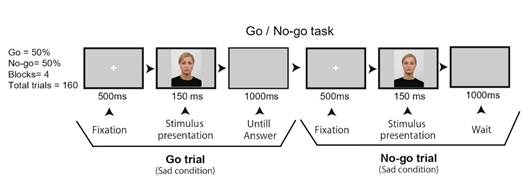
Fig 1. Go/No-Go task with Sad and Neutral face stimuli.
2.3 STAI-R
The Spielberger State-trait-anxiety Scale (STAI) (Spielberger, 1982) in its local adaptation (Leibovich de Figueroa, 1991) was used for the evaluation of anxiety. This scale is a tool widely recognized for its construct validity and its ability to differentiate between state-anxiety and trait-anxiety.
The STAI consists of 40 items: 20 for state-anxiety (STAI-S) and 20 for trait-anxiety (STAI-R). There are four response options that are scored on a Likert-type scale (0 to 3).
2.4 Procedure
As soon as the participants arrived, they were given an informed consent form and the examiner read it aloud while the participant followed the text on their copy. After signing the informed consent, they were asked to sit in front of a PC (SENTEY Corei7 7th Generation 3.60GHz microprocessor) where they completed three questionnaires: the Anxiety-Rash Inventory (Spielberger, 1982), the Edinburgh Laterality Inventory (Oldfield, 1971), and the Eysenck Reduced and Revised Personality Scale (Eysenck et al., 1985). After subjects completed the questionnaires (~10 min), they began the experimental task, which consisted of a Go/No-Go task, in which participants were instructed to press a button upon encountering a sad (or neutral) face. Go condition, 50 % of trials, and refrain from responding when presented with a neutral (or sad) face. No-Go condition, 50 % of trials. The proportion of stimulus presentation was: sad (50 %), neutral (50 %). Subjects performed four blocks of 40 trials, making a total of 160 trials (40 Go-sad, 40 No-Go sad and 40 Go-neutral and 40 No-Go neutral). The presentation times for the task were: 500 ms fixation point and 150 ms stimulus presentation. All participants were instructed to press a key with their right hand during the Go condition and to refrain from pressing the key during the No-Go condition. The order of instructions changed randomly among participants. On Go trials, there was a waiting time of ~200 ms after participants' response, whereas on No-Go trials, participants had to wait 1 s until the next trial began (Figure 1). This task was based on the one developed by Steinweg et al. (2021), but a stimulus presentation of 150 ms was used instead of 100 ms. For the task, ten practice trials were conducted to ensure that the task was understood. A minimum performance criterion of 75 % was set for all conditions in the Go/No-Go task. This criterion was taken from Jongen & Jonkman (2008) and is based on the fact that perfect performance in one condition is invalidated by poor performance in another. Performance must be uniform across conditions to ensure subject engagement with the task. The four conditions were labeled as follows: for sad trials, Go-sad (press the correct key when a sad face was presented), No-Go neutral (inhibit response when a neutral face was presented). For neutral trials, Go-neutral (press the correct key when a neutral face was presented), No-Go sad (inhibit response when a sad face was presented). It is important to note that in both No-Go trials, the labels were based on the type of stimulus presented on the monitor. After the end of the session, participants were asked if they used any strategy to solve the task and it was scored.
The main focus of this experiment was to assess participants' ability to maintain and correctly apply a specific set of tasks in the Go/No-Go task with sad and neutral faces.
2.5 Inclusion Criteria
In order to contribute to the validity of the results and to decrease variability due to misunderstanding or inconsistent performance during the task, only subjects who demonstrated a performance equal to or higher than 75 % of correct responses in the total of all conditions of the Go/No-Go task were considered. Such percentage was applied in the four experimental conditions: Go-sad, No-Go sad, Go-neutral, No-Go neutral.
A total of 31 participants (24 females) met the aforementioned inclusion criteria and were included in the statistical analysis.
2.6 Design and statistical analysis
To examine the impact of emotion and action on the performance of these subjects, a 2x2 repeated measures ANOVA was employed. The within-subject variables were Emotion (with two levels: Sad and Neutral) and Action (with two levels: Go and No-Go).
3. Results
The analysis of the effect of the variables emotion and action on performance was carried out with the participants who met the inclusion criteria (n=31). A 2x2 repeated measures ANOVA was applied on these data, with the variables Emotion (Sad, Neutral) and Action (Go, No-Go). A Greenhouse-Geisser correction for sphericity violations was applied. The results revealed a main effect of emotion (F(1)=12.94, p=0.001). Participants performed significantly worse to sad faces than to neutral faces. And an interaction between emotion and action (F(1)=44.16, p<0.001). Post hoc analysis indicates that subjects performed significantly worse in the No-Go sad condition than No-Go neutral (p<0.001).
The STAI-R questionnaire scores, considered as dependent variable shows no effect on the performance of the subjects pra the Go and No Go conditions. But, if we divide the subjects into two groups based on the 10 highest STAI-R scores and the 10 lowest STAI-R scores, we find interaction effects.
Applying the same statistical analysis for the STAI Low group, the main effect of emotion disappears (F(1)=1.88, p=0.209), i.e., subjects showed similar performance for sad and neutral faces. Although the interaction emotion and action is maintained (F(1)=7.01, p=0.03). Post hoc analysis revealed that performance in the sad No-Go condition showed a trend toward statistical significance compared to the neutral No-Go condition (p=0.104). In contrast, when we applied the same analysis to the STAI High group, we observed that not only is the main effect of emotion preserved (F(1)=5.66, p<.05) with subjects
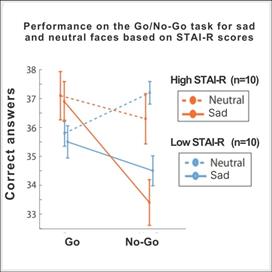 |
performing worse in the sad faces condition, but now an action main effect appears (F(1)=7.43, p<.05) where performance in the No-Go condition (inhibition) is significantly worse than in the Go condition (Fig. 2).
Fig 2. Performance in Go/No-Go task for sad and neutral faces based on STAI-R score between groups: STAI-R High (n=10) and STAI-R Low (n=10).
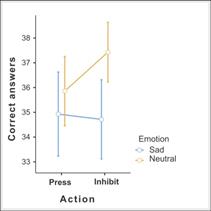
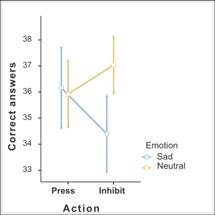
Finally, the emotion-action interaction is marginally conserved (F(1)=18.23, p=0.08). The post-hoc analysis shows us that there is a significant difference between the Go-sad and No-Go sad condition (p<0.05) and between the No-Go sad and Go-neutral condition (p<0.05) and marginally between No-Go sad vs No-Go neutral (p=0.06) (Fig. 3 & Fig. 4).
 |
 |
||
Fig 3. STAI-R Low
4. Discussion
The results of the present study demonstrate that non-threatening, negatively valenced emotional stimuli, such as sad faces, affect inhibitory control, particularly in individuals with high trait-anxiety. Specifically, significantly poorer performance was observed in the No-Go sad condition compared to all other experimental conditions (No-Go neutral, Go-neutral, Go-sad). This difficulty was more pronounced among participants with high scores on the STAI-R scale, who showed more commission errors when attempting to inhibit responses to sad faces, whereas their performance with neutral stimuli did not differ significantly from that of the low trait-anxiety group.
These findings extend previous evidence on the impact of anxiety on cognitive control (Grillon et al., 2017; Xia et al., 2020) by showing that even sad but non-threatening emotional stimuli can interfere with executive tasks such as response inhibition, particularly in individuals with a stronger anxious predisposition. This pattern supports the idea that trait-anxiety modulates the interaction between emotion and cognition, aligning with studies describing affective hypervigilance in anxious individuals, who tend to interpret even ambiguous or mildly negative emotions as signals of threat (Knyazev et al., 2008; Knyazev et al, 2009).
Consistent with the introduction, which highlighted the lack of research focused on non-threatening negative valence stimuli such as sadness (Fox et al., 2001), our results provide novel empirical evidence: sadness, like anger or fear, can interfere with inhibitory processes. Moreover, this interference is not uniform but depends on the individual’s emotional profile. The low trait-anxiety group showed no significant effects when exposed to sad stimuli, suggesting that emotional interference is not determined solely by stimulus characteristics, but also by stable individual differences such as trait-anxiety.
These results also differ from those reported by Storbeck, Stewart, and Wylie (2024), who found that emotions such as sadness can facilitate inhibitory control. This discrepancy may be explained by key methodological differences. While Storbeck et al. (2024) used emotional induction paradigms, where participants internalize the emotion, the present study introduced emotions as exogenous, salient stimuli within a cognitive task. This distinction is important because an induced emotion can activate self-regulatory mechanisms and enhance executive control, whereas a visual emotional stimulus, particularly for individuals with high trait-anxiety, may involuntarily capture attention and compete for the cognitive resources needed for inhibition.
Thus, the present findings support the hypothesis that trait-anxiety amplifies emotional interference even when the stimuli are not overtly threatening. This result aligns with the idea that individuals with high trait-anxiety show attentional biases toward negative emotional information and have a reduced capacity to disengage from it (Pacheco-Unguetti et al., 2012), which affects their performance on tasks that require executive control.
These findings have both theoretical and practical implications. Theoretically, they reinforce the importance of accounting for individual differences in models of emotion–cognition interaction. Practically, they highlight the need for personalized intervention strategies, particularly those aimed at strengthening inhibitory control in individuals with anxious profiles, through the training of attentional skills and emotional regulation.
Future research should examine this interaction using combined methodological approaches (emotional induction, executive tasks, neuroimaging) and include a broader range of emotions and levels of emotional processing. It would also be valuable to investigate the role of conscious emotional regulation strategies in the impairment of inhibitory control among individuals with high trait-anxiety, in order to inform the development of interventions that integrate both cognitive and affective aspects of executive functioning.
5. Conclusion
The results of this study suggest that trait-anxiety negatively influences the inhibitory control of responses to emotional stimuli, particularly when these stimuli have negative valence, even if they are not explicitly threatening. Specifically, individuals with high trait-anxiety scores showed significantly poorer performance in response inhibition during the Go/No-Go task when confronted with sad faces compared to neutral faces. This pattern was also observed, though to a lesser extent, in participants with low trait-anxiety, suggesting that trait-anxiety may amplify the difficulty of inhibiting responses to negative emotional stimuli.
Although the presence of emotional stimuli (sad faces) made response inhibition more challenging for all participants, the effects were more pronounced among those with high trait-anxiety. This suggests that trait-anxiety not only impairs inhibitory control more broadly but also intensifies specific difficulties when facing emotionally negative stimuli, even when they do not represent a clear threat.
These findings have important implications for understanding how trait-anxiety affects the interaction between emotional processing and inhibitory control. In practical terms, they suggest that people with high levels of trait-anxiety may face greater challenges in everyday situations that require inhibiting impulsive responses to non-threatening emotional cues. This insight could be valuable for designing interventions and therapies aimed at improving emotional regulation and cognitive control in individuals with anxiety-related vulnerabilities.
However, it is important to acknowledge certain limitations of this study. The relatively small sample size, especially within the high and low anxiety subgroups, limits the generalizability of the findings. Additionally, dividing participants into groups based on extreme trait-anxiety scores (high and low) may have introduced biases. Moreover, the exclusive use of sad and neutral faces as emotional stimuli restricts the conclusions to these specific emotional categories. Future studies would benefit from including a wider range of emotional stimuli (such as fear, anger, or joy) and larger, more representative samples. It would also be valuable to explore how other dimensions of anxiety, such as state-anxiety or social anxiety, interact with inhibitory control in emotionally demanding contexts.
In summary, although this study offers relevant insight into how trait-anxiety affects inhibitory control in the presence of emotional stimuli, further research is needed to fully understand the underlying mechanisms and to develop more comprehensive approaches for addressing anxiety.
References
Ansari, T. L., & Derakshan, N. (2010). Anxiety impairs inhibitory control but not volitional action control. Cognition and Emotion, 24(2), 241–254. https://doi.org/10.1080/02699930903381531
Berggren, N., & Derakshan, N. (2014). Inhibitory deficits in trait anxiety: Increased stimulus-based or response-based interference? Psychonomic Bulletin & Review, 21(5), 1339–1345. https://doi.org/10.3758/s13423-014-0611-8
Endler, N. S., & Kocovski, N. L. (2001). State and trait anxiety revisited. Journal of Anxiety Disorders, 15(3), 231–245. https://doi.org/10.1016/S0887-6185(01)00060-3
Eysenck, S. B., Eysenck, H. J., & Barrett, P. (1985). A revised version of the Psychoticism scale. Personality and Individual Differences, 6(1), 21–29. https://doi.org/10.1016/0191-8869(85)90026-1
Fox, E., Russo, R., Bowles, R., & Dutton, K. (2001). Do threatening stimuli draw or old visual attention in subclinical anxiety? Journal of Experimental Psychology: General, 130(4), 681–700. https://doi.org/10.1037/0096-3445.130.4.681
Grillon, C., Robinson, O. J., Krimsky, M., O’Connell, K., Alvarez, G., & Ernst, M. (2017). Anxiety-mediated facilitation of behavioral inhibition: Threat processing and defensive reactivity during a go/no-go task. Emotion, 17(2), 259–266. https://doi.org/10.1037/emo0000214
Jongen, E. M., & Jonkman, L. M. (2008). The developmental pattern of stimulus and response interference in a color-object Stroop task: An ERP study. BMC Neuroscience, 9, Artículo 82. https://doi.org/10.1186/1471-2202-9-82
Kessler, R. C. (2007). The global burden of anxiety and mood disorders: Putting the European Study of the Epidemiology of Mental Disorders (ESEMeD) findings into perspective. The Journal of Clinical Psychiatry, 68(Suppl 2), 10–19.
Knyazev, G. G., Bocharov, A. V., Slobodskaya, H. R., & Ryabichenko, T. I. (2008). Personality-linked biases in perception of emotional facial expressions. Personality and Individual Differences, 44(5), 1093–1104.
Knyazev, G. G., Bocharov, A. V., & Slobodskoj-Plusnin, J. Y. (2009). Hostility- and gender-related differences in oscillatory responses to emotional facial expressions. Aggressive Behavior, 35(6), 502–513. https://doi.org/10.1002/ab.20318
Langner, O., Dotsch, R., Bijlstra, G., Wigboldus, D. H. J., Hawk, S. T., & van Knippenberg, A. (2010). Presentation and validation of the Radboud Faces Database. Cognition and Emotion, 24(8), 1377–1388. https://doi.org/10.1080/02699930903485076
Leibovich de Figueroa, N. B. (1991). Ansiedad: Algunas concepciones teóricas y su evaluación. En M. M. Casullo, N. B. Leibovich de Figueroa & M. Aszkenazi (Eds.), Teoría y técnicas de evaluación psicológica (pp. 123–155). Psicoteca Editorial.
Leyman, L., De Raedt, R., Schacht, R., & Koster, E. H. W. (2007). Attentional biases for angry faces in unipolar depression. Psychological Medicine, 37(3), 393–402. https://doi.org/10.1017/S003329170600910X
Leyman, L., De Raedt, R., & Koster, E. H. W. (2009). Attentional biases for emotional facial stimuli in currently depressed patients with bipolar disorder. International Journal of Clinical and Health Psychology, 9(3), 393–410.
Norman, D. A., & Shallice, T. (1986). Attention to action: Willed and automatic control behavior. In R. J. Davidson, G. E. Schwartz, & D. Shapiro (Eds.), Consciousness and self-regulation (pp. 1–18). Plenum Press.
Oldfield, R. C. (1971). The assessment and analysis of handedness: The Edinburgh inventory. Neuropsychologia, 9(1), 97–113. https://doi.org/10.1016/0028-3932(71)90067-4
Pacheco-Unguetti, A., Acosta, A., Lupiáñez, J., Román, N., & Derakshan, N. (2012). Response inhibition and attentional control in anxiety. Quarterly Journal of Experimental Psychology, 65(4), 646–660. https://doi.org/10.1080/17470218.2011.637114
Schulz, K. P., Fan, J., Magidina, O., Marks, D. J., Hahn, B., & Halperin, J. M. (2007). Does the emotional go/no-go task really measure behavioral inhibition? Convergence with measures on a non-emotional analog. Archives of Clinical Neuropsychology, 22(2), 151–160. https://doi.org/10.1016/j.acn.2006.12.001
Spielberger, C. D., Gorsuch, R. L., & Lushene, R. (1982). Manual del Cuestionario de Ansiedad Estado/Rasgo (STAI). TEA Ediciones.
Steinweg, A. L., Schindler, S., Bruchmann, M., Moeck, R., & Straube, T. (2021). Reduced early fearful face processing during perceptual distraction in high trait anxious participants. Psychophysiology, 58(6), e13819. https://doi.org/10.1111/psyp.13819
Storbeck, J., Stewart, J. L., & Wylie, J. (2024). Sadness and fear, but not happiness, motivate inhibitory behaviour: The influence of discrete emotions on the executive function of inhibition. Cognition and Emotion, 38(8), 1160–1179. https://doi.org/10.1080/02699931.2024.2349281
Victor, T. A., Furey, M. L., Fromm, S. J., Öhman, A., & Drevets, W. C. (2010). Relationship between amygdala responses to masked faces and mood state and treatment in major depressive disorder. Archives of General Psychiatry, 67(11),1128–1138. https://doi.org/10.1001/archgenpsychiatry.2010.144
Xia, L., Mo, L., Wang, J., Zhang, W., & Zhang, D. (2020). Trait anxiety attenuates response inhibition: Evidence from an ERP study using the Go/NoGo task. Frontiers in Behavioral Neuroscience, 14, Artículo 28. https://doi.org/10.3389/fnbeh.2020.00028